Short Circuit & Arc Flash Studies
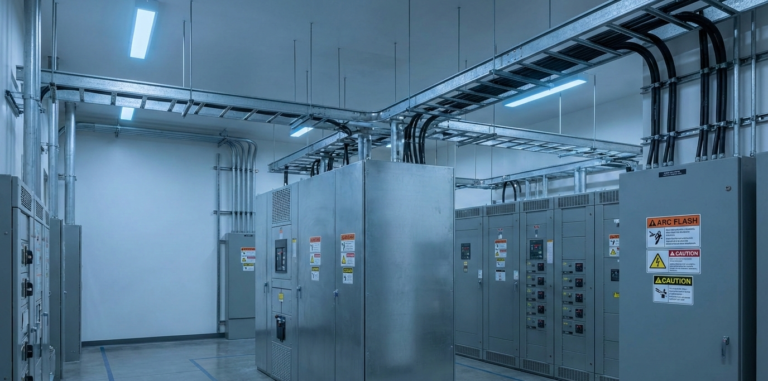
Short Circuit Coordination & Arc Flash (SCCAF)
Short Circuit Coordination and Arc Flash (SCCAF) studies are essential power systems engineering services that protect people, equipment, and operations from dangerous electrical faults while supporting Code compliance and uptime. Break Engineering provides comprehensive SCCAF studies for commercial, industrial, and institutional facilities across Canada, with a focus on practical, constructible solutions that integrate seamlessly with your electrical design.
What SCCAF Studies Include
- ▶ Short-circuit analysis to determine available fault current at each point in the distribution system and verify that switchgear, panelboards, MCCs, and other devices have adequate interrupting and withstand ratings.
- ▶ Protective device coordination studies to optimize relay, breaker, and fuse settings for selective tripping, minimizing outage impact and improving system reliability.
- ▶ Consolidated SCCAF reporting with clear recommendations, single-line diagrams (SLD), time–current curves, and mitigation options such as revised settings, protection upgrades, and arc-resistant strategies.
Arc flash hazard analysis using the IEEE 1584 calculation methodology to determine incident energy levels and arc flash boundaries, reported in compliance with CSA Z462 Workplace Electrical Safety requirements to establish required PPE categories for qualified workers.
Safety, Compliance, and Codes
Our SCCAF services support compliance with the Canadian Electrical Code, the National Building Code of Canada, and applicable provincial regulations. Arc flash studies are conducted using the IEEE 1584 arc flash calculation standard and reported per CSA Z462 Workplace Electrical Safety — Canada's primary electrical safety standard governing arc flash requirements, PPE selection, and safety procedures for energized electrical work. We help owners and operators implement engineered electrical safety controls, including properly coordinated protection, documented incident energy levels, and field-applied arc flash labels on switchgear, switchboards, MCCs, panelboards, and control panels.
Deliverables and Implementation
- ▶ Detailed SCCAF study report summarizing fault levels, device coordination results, and arc flash calculations, supported by model outputs and engineering commentary.
- ▶ Time–current coordination curves identifying optimized settings to reduce clearing times and, where feasible, lower incident energy at critical equipment.
- ▶ Arc flash labels indicating incident energy, working distance, arc flash boundary, and minimum PPE level, prepared for application on all in-scope electrical equipment.
- ▶ Practical mitigation recommendations, such as revised protection settings and equipment upgrades to balance electrical safety, reliability, and project budget.
SCCAF Study Applications
Break Engineering's SCCAF services support new construction, expansions, and retrofit projects requiring short-circuit studies, protective device coordination, and arc flash analysis for commercial, industrial, and mission-critical facilities. Typical applications include data centers, manufacturing plants, food processing facilities, water and wastewater treatment plants, mining operations, and large commercial buildings that demand robust electrical safety, coordinated protection, and compliant arc flash labelling.
SCCAF studies are often performed alongside or following Power & Distribution System design — once the electrical distribution architecture is established, a short-circuit study verifies that all devices have adequate interrupting ratings and that protection is properly coordinated end-to-end. For existing facilities, our Building Assessments frequently identify aging protective devices or undocumented system changes that warrant a full SCCAF study — we can scope both together. Whether you need a standalone SCCAF study or an integrated study as part of a new distribution design, Break Engineering delivers both.
Contact us today to discuss your SCCAF study requirements.